23Policy & Archive · Chronology

1973 → 2026

Fifty-three years in seven eras: a childhood in the GDR, a chemistry degree, seventeen years in the Bundestag, five as a state secretary, a decade in the energy industry and, since May 2025, the economics and energy ministry. Scroll sideways, or jump to an era.

Eras
7
Dated events
48
Status
As of October 2026

Illustrated timeline

Saffron markers indicate key events
  1. Early life
    1973

    Born in Luckenwalde

    16 July, in the GDR's Bezirk Potsdam, about 50 km south of Berlin. Her mother is a chemist and her father a chemical engineer.

    Early life
    1989

    The Wall falls

    She is 16 in November 1989 and finishes school in reunified Germany.

    Growing up in the GDR
    1992

    Abitur

    Leaves the Gymnasium in Luckenwalde, the home town of Rudi Dutschke.

    Early life
  2. Education
    1992

    Chemistry in Potsdam

    Begins chemistry at the newly founded University of Potsdam.

    Education
    1995

    Clarkson University

    Research assistant at the Institute of Chemistry and Biology, Potsdam, New York.

    Studies abroad
    1997

    Diplom-Chemikerin

    Graduates with the top grade of 1.0 after two research stays at the University of Turku, Finland. Then research associate in Potsdam until 1998.

    The scientific background
  3. Political beginnings
    1992

    RCDS and Junge Union

    Founding member of the Christian Democratic student group at Potsdam university; joins the Junge Union and its Brandenburg executive.

    Political beginnings
    1996

    Joins the CDU

    Later chairs the Frauen Union in Potsdam-Mittelmark.

    First party roles
    1998

    Into the Bundestag at 25

    Stands in Potsdam on 27 September and enters parliament on 26 October via the Brandenburg list.

    Bundestag
  4. Bundestag
    2000

    CDU federal executive

    Elected to the party's Bundesvorstand, where she sits until 2010 and again from 2014 to 2016.

    CDU career
    2002

    Stem-cell motion

    Co-sponsors, with Schäuble, Süssmuth and Pflüger, the most permissive motion on importing embryonic stem cells.

    Parliamentary work
    2002

    Stoiber's campaign team

    Named in July; "family" is removed from her brief after church objections.

    The controversy
    2005

    Deputy group chair

    After chairing the group's education and research working group from 2002, she becomes deputy chair of the CDU/CSU parliamentary group in late 2005.

    Bundestag
    2008

    Potsdam CDU chair

    Wins a contested vote, 152 to 129, on 8 July; holds the post until 2015.

    CDU career
  5. Government
    2009

    State secretary, environment

    Parliamentary State Secretary under Norbert Röttgen, later Peter Altmaier.

    Federal government
    2011

    Delhi consultations

    Takes part in the first German-Indian government consultations in May.

    International
    2011

    Votes for the nuclear exit

    On 30 June, after Fukushima, votes for ending nuclear power by 2022, having backed lifetime extensions in 2010.

    Energy policy
    2012

    Defends the solar cut

    On 9 March argues in the Bundestag that solar cannot be fed permanently by subsidies.

    Case study
    2012

    Civil partnerships row

    An August article in Bild opposing equal status draws a storm of criticism.

    Controversies
    2013

    Wins Potsdam directly

    On 22 September takes the constituency with 32.6 per cent, 730 votes ahead of the SPD.

    Bundestag
    2013

    To the transport ministry

    State secretary under Alexander Dobrindt, formally from 17 December: road safety, electromobility, eastern states.

    Federal government
  6. Industry
    2015

    Chief executive, VKU

    Elected in February, which sparks a debate on cooling-off periods. Takes office on 1 September and leaves the Bundestag on 4 September.

    The cooling-off debate
    2016

    President of CEEP

    Leads the European public-services employers' association until 2019. In December loses her seat on the CDU executive.

    Professional career
    2018

    Coal commission

    Member of the federal commission that recommends ending coal power by 2038.

    Professional career
    2020

    CEO of Westenergie

    From 1 January heads E.ON's largest subsidiary, a major grid operator based in Essen.

    Professional career
    2020

    Hydrogen council chair

    Elected chair of the new National Hydrogen Council in July.

    Hydrogen
    2021

    "The rest of the world isn't sleeping"

    In March the council criticises slow implementation of the hydrogen strategy.

    Case study
    2023

    Schaeffler board

    Elected to the supervisory board of Schaeffler AG on 20 April.

    Professional career
    2025

    Honorary professor

    MCI Management Center Innsbruck appoints her in April.

    Education
  7. Minister
    2025

    Federal minister

    Presented by Friedrich Merz on 28 April; sworn in on 6 May as Federal Minister for Economic Affairs and Energy, succeeding Robert Habeck.

    The ministry
    2025

    Washington

    First official visit to the US, 18–21 June, amid the tariff dispute.

    Trade
    2025
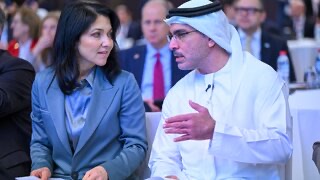
    Katherina Reiche at a meeting with an Emirati delegation
    At a meeting with an Emirati delegation.

    UAE business council

    With Sultan Al Jaber, witnesses the launch of a UAE-Germany Business Council in Berlin in July.

    Partners
    2025

    "Work more and longer"

    Pension remarks in a FAZ interview, reported 25 July, cause a row.

    Controversies
    2025

    Compliance answers

    On 4 August the government answers the Greens on her disclosures (Drucksache 21/1136).

    Controversies
    2025

    The reality check

    Presents the energy-transition monitoring report and a ten-point plan on 15 September.

    Case study
    2025

    Goyal and Kyiv

    Hosts India's commerce minister on 23 October and visits Kyiv on 24 October.

    Ukraine
    2025

    CO2 storage law

    The KSpG amendment enters into force on 28 November.

    Case study
    2026

    Price relief begins

    From 1 January: no gas storage levy, €6.5 bn grid-fee subsidy, lower electricity tax for industry.

    Case study
    2026

    Deal with Brussels

    Agreement in principle on 12 GW of new power plants, 15 January.

    Case study
    2026
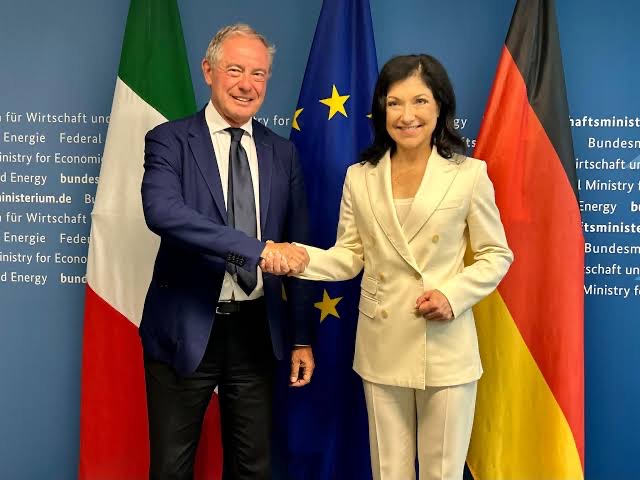
    Katherina Reiche shaking hands with an Italian counterpart in front of Italian, EU and German flags
    Shaking hands with an Italian counterpart in front of Italian, EU and German flags.

    Europe's gas rules

    The EU ban on Russian gas imports enters into force on 3 February.

    Europe
    2026

    Munich and Paris

    Munich Security Conference and IEA ministerial meeting in February.

    Forums
    2026

    The noon rule

    During the Hormuz shock, the fuel-price law takes effect on 1 April.

    Case study
    2026

    Industrial electricity price

    Approved by the European Commission on 16 April.

    State aid
    2026

    China visit

    Meets Commerce Minister Wang Wentao on 27 May.

    Trade
    2026

    Two laws in two days

    The capacity law passes the Bundestag on 9 July and the heating law on 10 July.

    Case study
    2026

    EEG reform in cabinet

    The end of fixed tariffs for new rooftop solar is adopted with the grid package, 29 July.

    Case study
    2026

    First auction closes

    4,500 MW of new capacity, significantly oversubscribed, 8 September.

    Case study
    2026

    Kyiv again; a court motion

    Talks in Ukraine reported on 5 October; Die Linke's motion at the Constitutional Court is pending.

    Controversies
Year by year

The same record, as text

A compact listing of every year with a documented event, for reading, printing and screen readers. Dates follow official CVs and the sources listed below.

1973
Born 16 July in Luckenwalde, Bezirk Potsdam, GDR.
1989
Aged 16 at the fall of the Berlin Wall.
1992
Abitur in Luckenwalde; begins chemistry at the University of Potsdam; co-founds the RCDS group there; joins the Junge Union.
1995
Research assistant at Clarkson University, USA.
1996
Joins the CDU.
1997
Research stays at the University of Turku; graduates as Diplom-Chemikerin (1.0); research associate in Potsdam.
1998
Enters the Bundestag on 26 October, aged 25, via the Brandenburg list.
2000
Elected to the CDU federal executive (to 2010).
2002
Stem-cell motion; member of Stoiber's campaign team (July); second daughter born 26 August; chairs the CDU/CSU working group on education and research (to 2005).
2003
Marries Sven Petke.
2005
Deputy chair of the CDU/CSU parliamentary group (to 2009).
2008
Elected chair of the CDU Potsdam district association on 8 July.
2009
Parliamentary State Secretary at the environment ministry from late October.
2010
Votes for nuclear lifetime extension (autumn).
2011
German-Indian government consultations in Delhi (May); votes for the nuclear phase-out on 30 June.
2012
Defends solar support cuts in the Bundestag (9 March); civil partnerships article (August); wins the CDU nomination for Potsdam against Saskia Ludwig (October).
2013
Wins the Potsdam constituency directly (22 September); state secretary at the transport ministry (formally from 17 December).
2014
Returns to the CDU federal executive (to 2016).
2015
Elected VKU chief executive (February); successor at the ministry appointed 11 February; takes up the VKU post 1 September; leaves the Bundestag 4 September.
2016
President of CEEP (June, to 2019); not re-elected to the CDU federal executive (December).
2018
Member of the coal commission (June 2018 – January 2019).
2019
Announces her move to E.ON (September).
2020
CEO of Westenergie (1 January); chair of the National Hydrogen Council (from June/July).
2021
Hydrogen council criticises slow implementation (March); Mestemacher Prize "Managerin des Jahres".
2023
Joins the Schaeffler supervisory board (20 April).
2025
Honorary professorship at MCI (April); presented as minister-designate (28 April); sworn in (6 May); Washington (June); UAE business council launch (July); working-time row (July); Drucksache 21/1136 (4 August); monitoring report (15 September); Goyal in Berlin and Kyiv visit (23–24 October); CCS law in force (28 November).
2026
Price relief in force (1 January); EU power-plant agreement (15 January); Russian gas ban in force (3 February); Munich Security Conference and IEA ministerial (February); CERAWeek (March); fuel-price law (1 April); industrial electricity price approved (16 April); China (May); Türkiye (June); capacity and heating laws passed (9–10 July); EEG reform in cabinet (29 July); EU approves up to €35 bn (2 September); first auction closes (8 September); Ukraine visit and court motion (October).