06Politics · Party

A party career built in parliament, not the apparatus

Katherina Reiche held seats on the CDU's federal executive for twelve years and led the party in Potsdam for seven, yet she never sat in the party's inner leadership. Her standing rested on her parliamentary roles and on her value to party leaders as a young, east German woman. When she returned in 2025 it was as Friedrich Merz's personal choice, with no party office and no seat in the Bundestag.

Member since1996 (Junge Union 1992)
Federal executive2000–2010, 2014–2016
Highest local officeChair, CDU Potsdam, 2008–2015
PresidiumNo documented membership
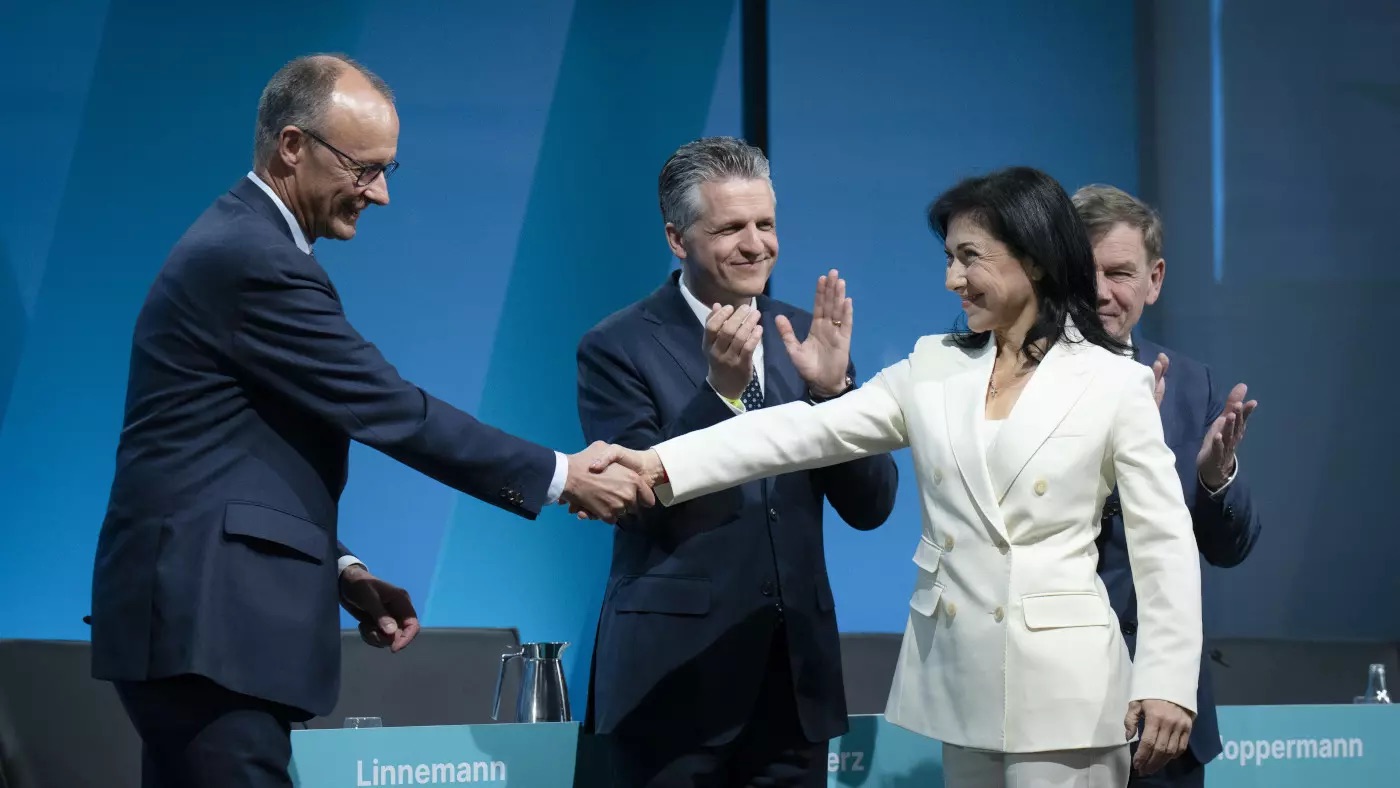
Katherina Reiche in a white suit shaking hands with Friedrich Merz on a stage in front of a blue backdrop
Katherina Reiche and Friedrich Merz shake hands on stage. Merz brought her back into front-line politics in 2025.
Offices over time

Thirty-four years in one chart

Bars show the documented duration of each office. A hatched end marks a date on which sources disagree; an open end marks a role whose end is not documented.

Junge Union (Brandenburg executive from 1992)
from 1992
CDU member
since 1996
CDU federal executive
2000–2010 · 2014–2016
CDU Brandenburg state executive
2001–2015 (or 2016)
EPP executive board
from 2002 · single source
Chair, CDU Potsdam
2008–2015
Member of the Bundestag
1998–2015
Federal minister (no party office)
since 2025

Sources: VKU CV (2019); Bundestag biographies; German Wikipedia, citing party-conference results and regional press. The Brandenburg end date is 2015 in Wikipedia and 2016 in the VKU CV.

Federal level

Twelve years on the federal executive

Verified fact Reiche was an ordinary elected member (Beisitzerin) of the CDU's federal executive, the Bundesvorstand, from 2000 to 2010 and again from 2014 to 2016. She first joined in 2000, the year Angela Merkel became party leader, and was 26 or 27 at the time. No source shows her as a member of the smaller Presidium, which forms the party's inner leadership.

The federal executive is the CDU's main governing body between party conferences, and its ordinary members are elected by the federal party conference. For a small eastern association such as Brandenburg's, a seat there was a mark of national relevance.

Her second spell ended abruptly. At the federal party conference in December 2016 she failed to be re-elected. The Potsdamer Neueste Nachrichten and the Tagesspiegel reported that the result left the Brandenburg CDU without any seat on the federal executive. By then she had left parliament and was running the municipal utilities association VKU.

Analysis The two spells map closely onto her parliamentary prominence. The first covered her years as a working-group chair, campaign-team member and deputy parliamentary group chair; the gap from 2010 to 2014 coincided with her time as a state secretary; and the second ended once she had left politics for industry. Her seat on the executive followed her standing in Berlin more than it reflected a power base in the party organisation.

Regional level

Brandenburg and Potsdam: contested ground

Unlike her federal roles, her regional offices had to be won in open votes, some of them close. They show a politician with a secure place in Berlin but a narrower base at home.

State executive. She sat on the executive of the CDU Brandenburg from 2001. German Wikipedia gives the end of her membership as 2015; her own 2019 CV at VKU gives 2016. This site does not resolve the discrepancy.

Potsdam district chair. In 2008 the chair of the CDU's Potsdam district association, Wieland Niekisch, resigned. To run for the post Reiche switched from the Potsdam-Mittelmark district association, where she had been active since the 1990s, to the Potsdam association. On 8 July 2008 she beat Hans-Wilhelm Dünn by 152 votes to 129.

The next contests followed the same pattern. She was confirmed unopposed in autumn 2009, but in April 2011 she held off a challenge from Andreas Ehrl by only six votes. Her majorities then grew: 73 per cent in March 2013 and 82.19 per cent in September 2014. On 9 September 2015, days after leaving the Bundestag for VKU, she stepped down. Steeven Bretz succeeded her.

Analysis A national figure who wins her local chair by 23 votes and then by six is not one who controls her home party. The improving results from 2013 coincide with her nomination for, and victory in, the Potsdam constituency, after which she was the area's directly elected member.

October 2012

The nomination contest with Saskia Ludwig

The clearest test of her regional standing came in October 2012, when the CDU in the Potsdam – Potsdam-Mittelmark II – Teltow-Fläming II constituency chose its candidate for the 2013 federal election. Her opponent was Saskia Ludwig, who shortly before had resigned as leader of both the Brandenburg CDU and its group in the state parliament.

Verified fact Reiche won with 223 of 409 votes. Handelsblatt described the meeting as a power struggle ("Machtkampf"). The contest set the sitting federal state secretary against the recently resigned regional leader, and the narrow result showed how evenly the local party was split.

The nomination proved valuable. On 22 September 2013 Reiche won the constituency directly for the first time, with 32.6 per cent of first votes, beating the SPD incumbent Andrea Wicklein by 730 votes. After four elections in which she had entered the Bundestag via the state list, she was now a directly elected member, a status she held until she left parliament in September 2015.

Positioning in the party

Modern in biography, conservative on marriage

Two episodes ten years apart show how she was placed inside the CDU: once as the face of a more modern Union, once as a defender of its traditional line.

2002

The Stoiber campaign team

Chancellor candidate Edmund Stoiber named the 28-year-old to his campaign team, originally for family policy. Catholic bishops and conservative Union politicians objected to an unmarried mother expecting her second child and to her support for stem-cell research, and "family" was removed from her brief. Stoiber and the party leader Angela Merkel defended her publicly.

The same month she backed the challenge by Bavaria, Saxony and Thuringia to the civil-partnership law, calling it an attack on marriage and family. The Federal Constitutional Court upheld the law on 17 July 2002.

The 2002 controversy in full

2012

The civil-partnership article

Political position In August 2012, while a state secretary, she wrote in Bild against giving registered civil partnerships the same status as marriage. The debate had been reopened within the governing coalition by FDP Justice Minister Sabine Leutheusser-Schnarrenberger.

Criticism The article drew a wave of hostile reaction, which the Süddeutsche Zeitung called a "Wutsturm", a storm of rage. She took her Facebook page offline for a time. Same-sex marriage was introduced in Germany on 1 October 2017.

Analysis The two episodes are less contradictory than they first appear. In 2002 the objections were to her private life and her bioethics; on family law she was already on the conservative side of the debate. Her profile in the party combined a modern biography, as a working mother from the east with a science career, with mainstream Christian Democratic positions on marriage. That combination made her useful to party leaders seeking to broaden the Union's appeal without changing its programme.

Analysis

Berlin first, Brandenburg second

Analysis Taken together, the record shows a politician whose career was driven from the federal level. Her promotions, to working-group chair, to Stoiber's campaign team, to deputy parliamentary group chair under Volker Kauder and to state secretary in two ministries, came from national leaders. Her regional offices were won later and with narrower majorities, and she gave them up as soon as she left the Bundestag.

The electoral arithmetic encouraged this pattern. In a state where she lost the constituency four times before winning it in 2013, a seat secured through the state list gave her a national platform without the need for a strong local base. It also left her exposed when her national role ended, as her failure to be re-elected to the federal executive in December 2016 showed.

The weakness was also a kind of independence. Because she owed little to a regional machine, she could move to the energy industry in 2015 and return to government ten years later without a party office to give up or reclaim.

2025 and after

The return: a minister without a mandate

Ten years after leaving politics, Reiche re-entered it at the top, through the patronage of the party leader rather than the party organisation.

The nomination

On 28 April 2025 Friedrich Merz presented his CDU ministers, first to the party Presidium and then to the press, shortly before the party's Bundesausschuss voted on the coalition agreement. Clean Energy Wire called Reiche his "surprise pick". General secretary Carsten Linnemann, long tipped for the economics post, had said on 15 April that he would remain in the party job.

Why her

Tagesschau wrote that the attributes "east German, woman, with experience in the energy industry" were likely to have suited Merz's cabinet planning. The choice annoyed the CDU in Saxony-Anhalt, which had hoped one of its own, Sven Schulze or Reiner Haseloff, would join the cabinet.

No seat, no office

She was sworn in on 6 May 2025. The Bundestag's master data show no mandate for her since 2015, so she is a minister without a parliamentary seat. No source shows her holding a party office at federal, state or district level since 2016.

Friction inside the Union

Her most persistent internal critic has been the CDU's labour wing. In July 2025 its deputy head Christian Bäumler called her a "Fehlbesetzung", a wrong appointment, over her call for longer working lives, and in April 2026 he demanded her dismissal after a clash with the SPD. Junge Union leader Johannes Winkel publicly backed her.

Standing with the chancellor

According to Der Spiegel (30 July 2026), Merz held what it called a kind of second job interview with her during the summer 2026 cabinet discussions, after which she kept her post. This site has not been able to check the paywalled report directly. Analysis Without a party office or a constituency of her own, her position depends more than most ministers' on the chancellor's confidence, a dependency that both protects and exposes her.

The ministry in detail