Katherina Reiche is economics minister as well as energy minister. She took office in a country whose manufacturing base is unusually large, whose energy-intensive industries have been shrinking since 2022, and whose growth forecasts were cut three times in her first year. This page brings together the numbers and her responses to them.
Katherina Reiche in conversation with a business leader at a conference table.
The industrial base
Why industry weighs more in Germany
Manufacturing produced almost a fifth of German gross value added in 2024 – nearly twice the French share and well above Italy's. That makes German economic policy unusually sensitive to industrial costs, above all energy.
Source: Destatis, Industrie in Europa (2024 data).
Germany19.9%
Italy16.6%
France10.7%
Manufacturing share of gross value added, 2024. Bar length relative to Germany.
Energy-intensive industry
Four years of decline
Energy-intensive sectors account for 75.6 per cent of industrial energy use (2024). Since the 2022 price shock their output has fallen faster than industry as a whole.
−15.2%
Production in energy-intensive industries, February 2022 to March 2026.
−9.5%
Production in industry as a whole over the same period.
−53,300jobs
Employment in energy-intensive sectors fell from 847,700 to 794,400 (about −6.3%, our calculation).
Source: Destatis, as reported by produktion.de, 2026.
Electricity prices
Germany's price gap
Ireland25.52
Cyprus24.29
Germany22.64
EU average18.37
€ per 100 kWh, non-household consumers using 500–2,000 MWh a year, second half of 2025. Germany is third-highest in the EU. Source: Eurostat, May 2026.
Analysis For mid-sized industrial users, German electricity cost about 23 per cent more than the EU average in late 2025 (our calculation). The gap is the backdrop to her two main industrial instruments: the relief package of January 2026 – grid-fee subsidy, permanent electricity-tax cut to the EU minimum, abolition of the gas storage levy – and the industrial electricity price approved by Brussels in April 2026.
The industrial price targets 5 ct/kWh for about 9,500 companies in 91 sectors, with €3.8 billion for 2026–2028; firms must reinvest at least half of the aid. The chemical association VCI called it "zu gering" (too small).
The government's GDP forecasts for 2026, as published by the economics ministry, and its estimate for 2025.
0.2%
1.3%
1.0%
0.5%
2025 · Oct 2025Autumn projection estimate for 2025
2026 · Oct 2025Autumn projection, 8 October 2025
2026 · Jan 2026Annual economic report, 28 January 2026
2026 · Apr 2026Spring projection, 22 April 2026
Verified fact The January 2026 annual report attributed about two-thirds of a percentage point of the expected growth to government stimulus. In April the ministry cited the Middle East conflict, the Hormuz blockade and protectionism for the cut to 0.5 per cent and forecast inflation of 2.7 per cent for 2026 and 2.8 per cent for 2027. The autumn 2026 projection, normally published in mid-October, had not appeared when this page was written.
Analysis The ministry attributed the downgrade mainly to external factors: an energy price shock and trade barriers. But the dependence on public spending for what growth remained underlines the argument of business groups, which Reiche shares, that structural costs – energy, labour, regulation – rather than demand are the core problem.
Instruments
Investment, raw materials and defence
Not every economic measure of the Merz government sits in her ministry. Where another department led, that is stated.
"Wachstumsbooster" – Finance-led
Verified fact The immediate investment programme was led by the Finance Ministry, not by Reiche. Adopted by the cabinet on 4 June 2025 and approved unanimously by the Bundesrat on 11 July 2025, it allows declining-balance depreciation of up to 30 per cent on movable assets bought between 1 July 2025 and the end of 2027, and cuts corporate income tax by one point a year from 2028, from 15 to 10 per cent.
The €500 billion special fund
Verified fact The fund for infrastructure and climate neutrality was created by a constitutional amendment in March 2025, before she took office. €100 billion goes to the Länder and €100 billion to the Climate and Transformation Fund. The implementing law was published on 2 October 2025. See Infrastructure.
Raw materials fund
Verified fact On 12 November 2025 she presented the first projects under a raw materials fund of about €1 billion to 2029: €150 million for lithium in the Upper Rhine, €150 million for a gold and copper project in Canada and €100 million for rare earths in Australia, each with private co-financing (regional Ippen outlet; single source).
Defence industry
Verified fact On 5 November 2025 the ministry's advisory group published a strategy paper on the defence industry, technology leadership and growth. At the Munich Security Conference in February 2026 she argued, in the ministry's account, that defence capability also means competitiveness, so that economic policy is always security policy too (paraphrase; the wording is from a search excerpt).
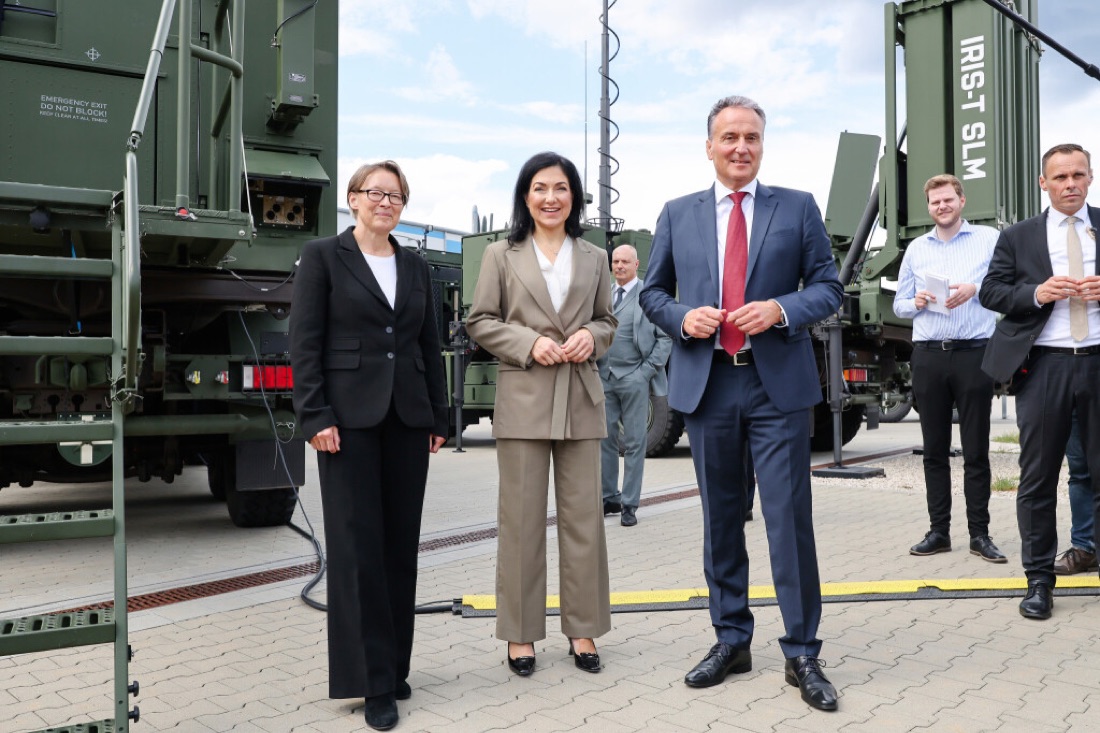
Katherina Reiche with officials during an outdoor site visit beside military vehicles – defence production is now part of the economics ministry's industrial agenda.
Trade
Tariffs, China and new partners
Her trade diplomacy has been shaped by US tariffs and by Germany's dependence on Chinese raw materials.
Selected trade-related engagements
Date
Where
Focus
18–21 Jun 2025
Washington DC
First official visit; meetings with Treasury Secretary Bessent and Trade Representative Greer on the EU–US tariff dispute. On 27 July 2025 the EU–US framework set a 15% US tariff on most EU goods; no verbatim reaction from Reiche was found.
23 Oct 2025
Berlin
Hosted India's Commerce Minister Piyush Goyal.
26–29 May 2026
China
Met Commerce Minister Wang Wentao on 27 May with a business delegation including BASF, Thyssenkrupp and Siemens Energy; rare earths on the agenda.
Jun 2026
Türkiye
Joint economic and trade committee (JETCO) and a German–Turkish energy forum, with about 30 business leaders.
In an interview with the Frankfurter Allgemeine Zeitung, reported on 25 July 2025, Reiche argued that Germans must work more over their lives. She compared roughly 1,340 annual working hours in Germany with about 1,800 in the United States.
"In the long run it cannot work that we only work two-thirds of our adult lives and spend one-third in retirement."
„Es kann auf Dauer nicht gut gehen, dass wir nur zwei Drittel unseres Erwachsenenlebens arbeiten und ein Drittel in Rente verbringen.“
Criticism
Christian Bäumler of the CDU's own labour wing called her a "Fehlbesetzung" (wrong person for the job), arguing that low average hours reflect high part-time work. The social association SoVD warned against raising the retirement age "durch die Hintertür". Labour Minister Bärbel Bas (SPD) said many workers already cannot reach the current retirement age for health reasons.
Support and response
Employers' president Rainer Dulger and the economist Martin Werding backed her. She defended the push and repeated it in November 2025. The cabinet set up a pension commission in December 2025.
Which indicators count?
Criticism
Verified fact For the annual economic report in 2026 she dropped the social and ecological indicators that had been added under her predecessor Robert Habeck to measure prosperity beyond GDP. Roland Zieschank of the IZT institute called the decision an "Ausdruck des Politikversagens" (an expression of policy failure), according to the Frankfurter Rundschau in May 2026.
Analysis The change fits her emphasis on growth and competitiveness, and fits the move of climate policy to another ministry. Critics see it as narrowing what the economics ministry is accountable for.
A windfall tax clash with the SPD
Political position
In April 2026 she called Finance Minister Lars Klingbeil's idea of a windfall tax expensive, ineffective and constitutionally questionable. Bäumler called for her dismissal; the Junge Union leader Johannes Winkel and the automotive association VDA backed her.
Seventeen months is short for industrial policy. Most measures have been legislated recently or apply from 2026, and the data that would show their effect – investment, output, employment in energy-intensive sectors – lag by months.
Verified fact One oversight issue has already surfaced. In August 2026 zdfheute reported that enforcement of the supply-chain due-diligence law at BAFA, an agency under her ministry, had stalled. The ministry replied that BAFA fulfils all legally mandated oversight tasks.
Energy costs
Analysis The relief package and industrial electricity price lower costs for eligible firms from 2026. The question is whether that narrows the 23 per cent gap to the EU average for mid-sized users, and whether the planned cut in grid-fee subsidies from 2027 reopens it.
Output
Analysis Energy-intensive production fell 15.2 per cent between February 2022 and March 2026. A stabilisation in 2026–2027 would support her approach; continued decline would strengthen critics who argue that relief is too small or too late.
Growth
Analysis The 2026 forecast fell from 1.3 to 0.5 per cent within six months, for reasons the ministry described as mainly external. The autumn 2026 projection, due in October, will be the next data point.
Labour
Political position Longer working lives remain her stated goal; the pension commission set up in December 2025 is where that debate now runs.