Hydrogen: from advisory council to ministry
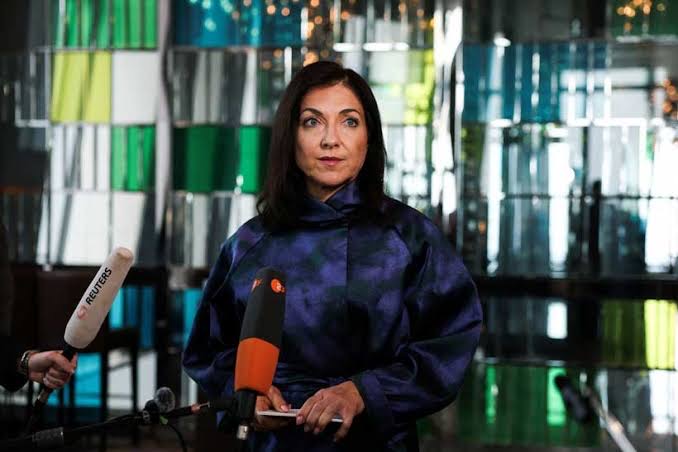
Few German politicians have spent as long on hydrogen as Katherina Reiche. She chaired the government's National Hydrogen Council for five years and ran a grid company that converted a public gas line to pure hydrogen. As minister she now owns the policy – including the decision to drop a fixed electrolysis target that the strategy she once advised on had set.
What hydrogen is for, and how it is made
Hydrogen (H₂) carries energy without releasing CO₂ when it is used. Whether it is low-carbon depends entirely on how it is produced.
The method at the centre of German policy is electrolysis: an electric current splits water into hydrogen and oxygen. If the electricity is renewable, the result is called green hydrogen. Electrolysis is energy-intensive, so the price of electricity largely determines the price of the hydrogen.
Hydrogen matters for the energy transition where direct electrification is hard: as a feedstock and reducing agent in steel and chemicals, as a fuel for power plants that must run when wind and sun are short, and as a way of storing energy over long periods. That is why German policy treats it as a system question – production, transport, storage and use have to grow together.
Green
Produced by electrolysis using renewable electricity. The stated long-term goal of German strategy.
Blue
Produced from natural gas, with the resulting CO₂ captured and stored. Depends on carbon capture and storage (CCS).
Grey
Produced from natural gas without capturing the CO₂. Today's conventional industrial route.
The hydrogen system, step by step
Where Germany stands at each stage of the chain, as of 2025–2026.
Electrolysis & imports
181 MW of electrolysers operating in January 2026; 1.3 GW under construction or past investment decision. The ministry plans to rely more on imports, for example from Morocco.
The core network
About 9,040 km of pipelines approved in October 2024, around 60% converted gas lines, to come online step by step until 2032. About 525 km were completed in 2025.
Balancing the system
Hydrogen can store renewable energy over long periods. The 2026 capacity law counts storage and flexible loads alongside hydrogen-ready plants.
Industry & power
Steel and chemicals, and new gas plants that must be hydrogen-ready and decarbonised by 2045 at the latest. Where hydrogen is not an option, CCS is the fallback for process emissions.
Sources: Clean Energy Wire (Jan 2026); Bundesnetzagentur and FNB Gas; ZfK; pv magazine (StromVKG, Jul 2026).
Five years as the government's hydrogen adviser
The federal cabinet adopted the National Hydrogen Strategy on 10 June 2020 and created the National Hydrogen Council alongside it: an independent body of 25 experts from business, science and civil society that answers the government's questions and issues recommendations. In July 2020 the members elected Reiche as chair. ZfK reported that she pledged to work for Germany taking a leading role in hydrogen technologies (paraphrase; the exact wording is not confirmed).
The council did not spare the government. In March 2021 it publicly criticised the slow implementation of the strategy – Handelsblatt headlined the episode "Watsche vom Wasserstoffrat" (a slap from the hydrogen council). Reiche was quoted:
"It's about picking up speed immediately. The rest of the world isn't sleeping. Other nations were faster than us and are also much more focused."
„Es geht darum, umgehend Fahrt aufzunehmen. Der Rest der Welt schläft nicht. Andere Nationen waren schneller als wir und sind zudem deutlich zielstrebiger“
"Electricity costs are the biggest cost driver in hydrogen electrolysis."
„Die Stromkosten sind der größte Kostentreiber bei der Wasserstoffelektrolyse.“
A hydrogen pilot in the distribution grid
At the same time she ran Westenergie, whose subsidiary Westnetz carried out the H2HoWi project in Holzwickede, North Rhine-Westphalia. From October 2022 to the end of 2023 it converted a public natural-gas line to 100 per cent hydrogen – the first such conversion in Germany, according to ZfK.
Criticism When she was named minister in April 2025, LobbyControl raised a specific concern: Westenergie wanted a connection to the planned hydrogen core network, which falls under the ministry's remit. The government has said that the legal rules on conflicts of interest apply and are followed. See Controversies.
The 10 GW target, and why it was dropped
The 2020 strategy set 5 GW of electrolysis by 2030; the 2023 update doubled it to 10 GW. In January 2026 the gap looked like this.
Bars to scale against 10 GW. Source: Clean Energy Wire, January 2026; Clean Energy Wire on the 2023 strategy revision.
Verified fact After the September 2025 monitoring report, whose ten-point plan called for "a pragmatic hydrogen ramp-up", the ministry said it would scrap the fixed 10 GW target in favour of a more flexible approach. As of January 2026 it had not presented a replacement figure.
Political position The ministry intends to place more weight on imports, naming Morocco as one example.
Analysis At 181 MW, Germany had built under 2 per cent of the target with four years to go, and even all projects in the pipeline would reach about 15 per cent. Dropping the number avoids a certain miss but also removes a benchmark against which investors and critics could measure progress. Her own 2021 point – that electricity costs drive hydrogen costs – helps explain the lag: domestic green hydrogen competes with industrial power prices that remain among the highest in the EU.
The core network and the acceleration act
The pipelines were approved before she took office; the law to build them faster was passed under her.
Hydrogen core network approved by the Bundesnetzagentur on 22 October 2024.
BNetzA via pv magazine, 2024Estimated investment cost of the core network.
FNB GasShare made up of converted natural-gas pipelines.
FNB GasCompleted in 2025. The full network is due by 2032.
ZfK, 2026Hydrogen Acceleration Act
Verified fact The cabinet adopted the draft Wasserstoffbeschleunigungsgesetz in October 2025. The exact date is unclear: some sources give 1 October 2025, while the ministry's press-release address carries "20251025". The Bundestag passed the act on 26 February 2026 and it was published in the Federal Law Gazette on 1 April 2026. It classifies hydrogen infrastructure as being in the "overriding public interest" and introduces digital permitting with fixed deadlines.
A reformed hydrogen council
Verified fact On 10 June 2026 the cabinet adopted a reform of the council she once chaired, on her proposal. All memberships ended on 30 June 2026, new bylaws took effect on 1 July, and the focus moved to market and economic questions. Felix Matthes of the Öko-Institut had chaired the council in the interim. The government's release explained the shift:
"Now that technical and regulatory foundations are built, economic aspects come to the fore in building a hydrogen market."
„Nach dem Aufbau technischer und regulatorischer Grundlagen rücken nun beim Aufbau eines Wasserstoffmarktes die wirtschaftlichen Aspekte stärker in den Vordergrund.“
- 10 Jun 2020
Strategy and council
Cabinet adopts the National Hydrogen Strategy; Reiche elected council chair in July.
- 23 Mar 2021
Public criticism
The council criticises slow implementation.
- 2023
Target doubled
Strategy update raises the 2030 electrolysis target to 10 GW.
- 22 Oct 2024
Core network approved
9,040 km, completion by 2032.
- Oct 2025
Acceleration act in cabinet
Draft adopted under Reiche as minister.
- Jan 2026
181 MW
Fixed 10 GW target to be dropped; no replacement yet.
- 26 Feb / 1 Apr 2026
Act passed and in the Gazette
Bundestag vote, then publication.
- 1 Jul 2026
Council relaunched
New bylaws, market focus.
H2-ready plants, CCS and storage
Hydrogen policy under Reiche is tied to two other files: new controllable power plants and the storage of CO₂.
Hydrogen-ready gas plants
Verified fact Of the 12 GW of new controllable capacity agreed with the European Commission in January 2026, 10 GW are long-term capacity – mainly gas plants that must be able to switch to hydrogen and be decarbonised by 2045 at the latest. The capacity law (StromVKG) passed the Bundestag on 9 July 2026.
Carbon capture and storage
Verified fact The amended Carbon Dioxide Storage Act passed the cabinet on 6 August 2025 and the Bundestag on 6 November 2025, and took effect on 28 November 2025. It allows industrial-scale storage of CO₂ offshore on the continental shelf and in the exclusive economic zone; marine protected areas and coastal waters are excluded. Reiche called it an important milestone for industries with unavoidable process emissions, such as cement and lime.
Storage and flexibility
Verified fact The capacity law covers storage and flexible loads as well as plants. Criticism April 2026 reports that the ministry had requested EnBW proposals that would disadvantage battery storage in the auctions raised doubts about technology neutrality.
Research priorities
Political position The ten-point plan lists hydrogen alongside deep geothermal, fusion, CCS/CCU and AI as research and innovation priorities.
Opportunities and challenges
Opportunities
A network is being built. The core network is approved and 525 km were complete by the end of 2025. Reusing about 60 per cent of existing gas pipelines lowers cost.
Faster permits. The acceleration act gives hydrogen projects priority status in planning law.
A route for heavy industry. Hydrogen and CCS together give steel, chemicals and cement a path to lower emissions where electricity alone cannot.
Challenges
Cost. As Reiche herself said in 2021, electricity is the biggest cost driver – and German industrial power prices are high.
Demand uncertainty. Pipeline operators need customers; production needs offtakers. The 2025 monitoring report lowered expected 2030 electricity demand, and energy-intensive industrial output has fallen since 2022.
Imports. A stronger import focus depends on partner countries, shipping or pipeline routes and contracts not yet in place.
No benchmark. With the 10 GW target withdrawn and no replacement as of January 2026, progress is harder to judge.
Analysis The fixed target has given way to an approach that puts infrastructure and market design ahead of volume goals. Whether that is pragmatism or a retreat is the central question about hydrogen under Reiche. The answer will depend on whether the network built by 2032 finds producers and customers.
- ZfK — Reiche chairs the National Hydrogen Council, Jul 2020
- Nationaler Wasserstoffrat — About the council
- Handelsblatt — "Watsche vom Wasserstoffrat", 23 Mar 2021
- ZfK — Westnetz H2HoWi project
- LobbyControl — Conflict-of-interest warning, Apr 2025
- pv magazine — Core network approved, 22 Oct 2024
- FNB Gas — Hydrogen core network
- ZfK — Core network progress
- WaterstofNet — Bundestag passes Hydrogen Acceleration Act
- IHK Ulm — Act published in the Federal Law Gazette
- Clean Energy Wire — Strategy revision doubles target
- Clean Energy Wire — Electrolyser capacity lags behind, Jan 2026
- Federal government — Reform of the National Hydrogen Council, 10 Jun 2026
- ZfK — "Wasserstoffrat: weniger Gremium, mehr Markt"
- Gleiss Lutz — The ten-point plan
- Solarserver — Power plant strategy agreed with the EU
- pv magazine — StromVKG passed
- Federal Government — Storage of carbon dioxide
- pv magazine — EnBW proposals on battery storage
- Eurostat — Non-household electricity prices, H2 2025