08Politics · Executive office

Three posts in federal government

Katherina Reiche has served the federal government in three capacities: as parliamentary state secretary for the environment during the Fukushima reversal, as state secretary for transport, and, since 6 May 2025, as Federal Minister for Economic Affairs and Energy. This page examines each period against the same ten questions.

2009–2013State Secretary, BMU
2013–2015State Secretary, BMVI
Since 2025Federal Minister, BMWE
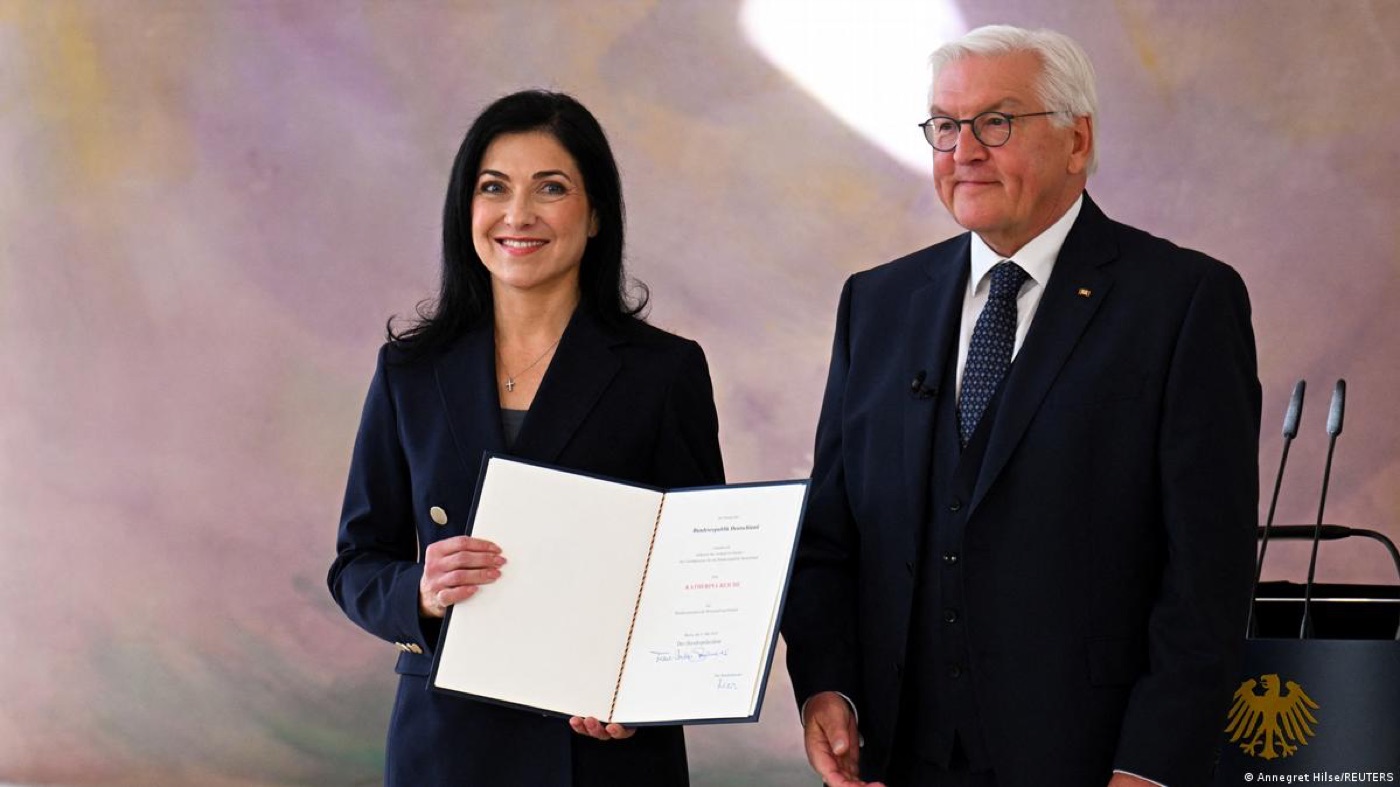
Katherina Reiche holding her certificate of appointment beside Federal President Frank-Walter Steinmeier
Katherina Reiche holds her certificate of appointment as federal minister, beside Federal President Frank-Walter Steinmeier, May 2025.
Two different offices

A parliamentary state secretary (Parlamentarische Staatssekretärin) is a member of parliament appointed to support a federal minister, mainly in dealings with the Bundestag, the Bundesrat and the parties. The post carries political, not administrative, responsibility: it does not head the ministry's civil service and has no cabinet vote. A federal minister leads a ministry independently and on her own responsibility within the chancellor's policy guidelines (Article 65 of the Basic Law) and sits in the cabinet.

Federal Ministry for the Environment, Nature Conservation and Nuclear Safety

State Secretary for the Environment

2009–2013

Appointment

After the September 2009 election the CDU/CSU and FDP agreed in their coalition talks to make Reiche parliamentary state secretary at the environment ministry (BMU). The transport ministry's official CV dates the post from 29 October 2009; the English Wikipedia gives 28 October. She had herself sat in the coalition working group on environment, agriculture and consumer protection.

Political context

The second Merkel government took office with a plan to extend the operating lives of Germany's nuclear plants, which the Bundestag approved in autumn 2010. After the Fukushima disaster in March 2011 the coalition reversed course. Renewable expansion, especially rooftop and ground-mounted solar, was rising fast, and with it the cost of feed-in support.

Responsibilities

She served under two ministers: Norbert Röttgen until May 2012 and Peter Altmaier from May 2012. Her internal division of portfolio within the BMU is not documented in an official source consulted for this page. Her parliamentary appearances show that she represented the ministry on renewable-energy legislation.

Major priorities

Political position In the Bundestag she argued that the Renewable Energy Sources Act (EEG) had to evolve into a "Marktfähigkeitsmodell", a model for market readiness, and restated the government's target of 35 per cent renewable electricity by 2020.

Policies

On 9 March 2012, at the first reading of the government's solar amendment (PV-Novelle), she defended cuts to photovoltaic feed-in support. According to the Bundestag's own report, she argued that a mass market such as photovoltaics could not be permanently fed by subsidies and said: "Die Industrie muss sich unabhängig behaupten" ("The industry must hold its own independently").

Initiatives

In May 2011 she took part in the first German–Indian government consultations in Delhi. No other initiatives can be attributed to her personally from the sources reviewed; legislation in this period was led by the minister.

Challenges

The nuclear reversal put the ministry's political leadership in the position of reversing, within a year, a policy it had just enacted. Reiche had long supported longer plant lifetimes and voted for the 2010 extension. On 30 June 2011, in a roll-call vote, she voted for the phase-out of nuclear power by 2022.

Outcomes

The phase-out law passed and the last three plants closed on 15 April 2023. Her term ended with the new Bundestag on 22 October 2013, after which she continued in a caretaker capacity; the Bundestag biography says she held the post until December 2013.

Criticism

Criticism Her highest-profile controversy of the period was not about environmental policy. In August 2012, writing in Bild, she opposed giving civil partnerships equal status with marriage. The Süddeutsche Zeitung described a storm of protest, and she took her Facebook page offline for a time.

Long-term significance

Analysis The BMU years gave her first-hand experience of energy legislation at the moment when cost became its central political problem. Her 2012 argument that solar should stand on its own in the market anticipates, almost word for word, her 2025 case for ending feed-in support for small rooftop systems.

Federal Ministry of Transport and Digital Infrastructure

State Secretary for Transport

2013–2015

Appointment

After she won her Potsdam seat directly in September 2013, she moved to the transport ministry. According to its official CV she served in a caretaker capacity from 22 October 2013 and was formally appointed on 17 December 2013, when the third Merkel government took office.

Political context

The new grand coalition of CDU/CSU and SPD had restructured the ministry, adding digital infrastructure to transport and placing it under Alexander Dobrindt (CSU). Reiche was one of several parliamentary state secretaries serving him.

Responsibilities

Her areas are documented through their redistribution when she left. Road safety, electromobility and regional responsibility for the eastern German states had lain with her. Budget and aviation passed to her successor, which suggests, without confirming, that they were hers too. She chaired the advisory board of the air navigation service Deutsche Flugsicherung (DFS).

Major priorities

No programme of her own is documented for this period. Electromobility was the policy area closest to her later work in energy.

Policies

No legislation can be attributed to her personally from the sources reviewed. A role in broadband or digital policy is often assumed because of the ministry's name, but it is not documented and is not stated here.

Initiatives

Her chairmanship of the DFS advisory board (2013–2015) is the one formal function that the VKU and federal government CVs both record from this period.

Challenges

The tenure was short. Her move to industry became public on 2 February 2015, about fourteen months after her formal appointment, and the ministry had to redistribute her portfolio at short notice.

Outcomes

Norbert Barthle was appointed her successor on 11 February 2015. Road safety went to Dorothee Bär, electromobility to Enak Ferlemann, and the eastern states were divided between them. She kept her Bundestag mandate until 4 September 2015.

Criticism

Criticism The switch from government to the municipal utilities' association VKU came as the cabinet prepared a cooling-off law for departing ministers and state secretaries. The SPD's Ralf Stegner said members of the government should set an example. The law passed on 2 July 2015 but did not apply to her case.

Long-term significance

Analysis The transport years are the least documented part of her career in government. Their main legacy was her exit, which made her a reference case in the German debate on the "revolving door" between government and lobbying.

Federal Ministry for Economic Affairs and Energy (BMWE)

Federal Minister for Economic Affairs and Energy

Since 2025
Nominated
28 April 2025, by CDU leader Friedrich Merz
Sworn in
6 May 2025, the day Merz was elected chancellor
Predecessor
Robert Habeck (Greens), Minister for Economic Affairs and Climate Action
Mandate
None. She is not a member of the Bundestag
Ex officio
Member of the supervisory board of KfW, the state development bank

Appointment

Merz presented her as minister-designate on 28 April 2025, ten years after she had left politics; Clean Energy Wire called her his "surprise pick". CDU general secretary Carsten Linnemann, long tipped for the post, had said on 15 April that he would stay in the party job. Tagesschau noted that the attributes "east German, woman, with experience in the energy industry" suited Merz's cabinet planning. Before taking office she ended all previous professional roles and mandates, according to the government.

Political context

She took over an economy that the government expected to grow by just 0.2 per cent in 2025, in a CDU/CSU–SPD coalition that could draw on a €500 billion special fund for infrastructure and climate neutrality, created by constitutional amendment in March 2025. Production in energy-intensive industry fell by 15.2 per cent between February 2022 and March 2026. From early 2026 the war involving Iran and the closure of the Strait of Hormuz drove up oil and gas prices.

Responsibilities: the organisational decree of 6 May 2025

The chancellor's organisational decree of 6 May 2025 reshaped the ministry Habeck had led:

  • Renaming. The Federal Ministry for Economic Affairs and Climate Action (BMWK) became the Federal Ministry for Economic Affairs and Energy (BMWE) (section II.1).
  • Climate out. Climate protection and climate partnerships moved to the environment ministry, renamed the Ministry for the Environment, Climate Action, Nature Conservation and Nuclear Safety (BMUKN) (section IX.1).
  • Transformation policy moved to the finance ministry (section III.2).
  • Innovation and space. Space policy including the DLR, basic questions of innovation and technology policy, the Hightech Agenda, gigafactories, SPRIND and games moved to the research ministry (BMFTR) (section X.1).
  • Digital. Better regulation, digital policy, data-use law and the digital economy moved to the new Ministry for Digital Affairs and State Modernisation (section XII.4).

What remains is a ministry concentrated on economic policy, industry, trade, and energy supply, markets and infrastructure.

Major priorities

Political position Cost efficiency and security of supply. In May 2025 she announced a "reality check" of the energy transition. The resulting monitoring report, presented on 15 September 2025, came with a ten-point plan: plan for 600–700 TWh of demand in 2030, end fixed feed-in tariffs, synchronise grids and renewables, and build hydrogen-ready gas plants. It kept the target of 80 per cent renewable electricity by 2030.

Policies

From 1 January 2026: abolition of the gas storage levy, a €6.5 billion subsidy for transmission-grid fees and electricity tax cut to the EU minimum for manufacturing. An industrial electricity price approved by the European Commission on 16 April 2026. The capacity law (StromVKG), the heating law (GModG), the CO2 storage reform (KSpG), the Hydrogen Acceleration Act and the fuel-price law (KPAnG), all passed. The legislative register

Initiatives

A first tender for 4,500 MW of new controllable capacity, which closed on 8 September 2026 and which the Bundesnetzagentur called significantly oversubscribed. A reform of the National Hydrogen Council, which she once chaired, adopted by the cabinet on 10 June 2026. A raw-materials plan of November 2025. Official visits to Washington, Kyiv, Paris (IEA), Houston (CERAWeek), China and Türkiye.

Challenges

The 2026 energy price shock, with Brent oil peaking at about $118 a barrel in late March. Gas storage at 57.4 per cent on 26 September 2026, about 19 points lower than a year earlier. The first German offshore wind auction to attract no bids (August 2025). A spring 2026 growth projection cut to 0.5 per cent. And the EU state-aid approval of the current EEG, which expires at the end of 2026.

Outcomes (as of October 2026)

According to the government, prices for new household electricity customers fell 6.7 per cent in January 2026, and it estimates household savings at about €160 a year. The capacity auctions are under way, with awards due by 3 November 2026. The 2027 EEG reform and grid package passed cabinet on 29 July 2026 and had its first reading on 24 September 2026. A gas reserve of about 24 TWh is planned from 2027.

Criticism

Criticism LobbyControl questioned on her nomination whether a former energy executive could keep "die nötige kritische Distanz" from the industry. Later criticism included reports that parts of the ten-point plan overlapped with RWE and E.ON papers; a Spiegel report that the ministry solicited gas-plant auction proposals from EnBW; her attendance at a private summit in Tyrol co-organised by her partner, about which she was questioned in the economic affairs committee; her call for longer working lives; and the Regulatory Control Council's verdict on the heating law. Environmental groups accuse her of slowing the energy transition. Business associations such as the BDI and BDEW have broadly welcomed her course. Controversies, analysed

Long-term significance

Analysis Her tenure marks a deliberate reorientation of German energy policy from volume targets towards cost, system integration and firm capacity. It also marks the end of the joined-up "economy and climate" ministry. Whether the shift lowers prices without derailing the 2030 and 2045 climate targets cannot yet be judged: most of her laws take effect from 2026 or 2027, and the federal environment agency's 2026 projections already showed a gap of about 30 million tonnes to the 2030 target.

Press account · July 2026 reshuffle

According to Der Spiegel (30 July 2026, "Der Absturz"), Merz held "eine Art zweites Bewerbungsgespräch" ("a kind of second job interview") with Reiche during the summer 2026 cabinet reshuffle, after which she kept the ministry. This is a single press report; the article is paywalled and has not been independently verified for this page. Earlier, in April 2026, the CDU labour wing's Christian Bäumler had called for her dismissal after a clash with the SPD finance minister.

Comparison

From junior office to cabinet

The three periods differ in kind, not only in rank. As a parliamentary state secretary she spoke for policies her ministers set, and much of her personal work is hard to trace in the record. As a minister she sets policy herself and is accountable for it to the Bundestag and the public, which is why the third period is documented in far more detail.

One line runs through all three. In 2012 she argued in parliament that solar power had to become viable in the market. In 2025 and 2026 she set out to end fixed feed-in support for new small solar systems. In between she ran a grid company and chaired the hydrogen council, and her ministerial agenda reflects that operator's view of the energy system: grids, firm capacity and cost.

Energy policy in detail

Sources
  1. Bundesregierung — Lebenslauf Katherina Reiche
  2. BMVI — CV of Parliamentary State Secretary Katherina Reiche (2014, archived)
  3. Deutscher Bundestag — Biografie, 18th electoral term
  4. Die Zeit, 24 October 2009 — "Die Köpfe der zweiten Reihe"
  5. Deutscher Bundestag text archive, 9 March 2012 — government defends solar cuts
  6. FAZ, 30 May 2011 — first German–Indian government consultations
  7. Süddeutsche Zeitung, 22 August 2012 — civil partnerships row
  8. VerkehrsRundschau, 12 February 2015 — Barthle appointed, portfolio redistributed
  9. VerkehrsRundschau, February 2015 — SPD criticises the switch
  10. Tagesschau, 28 April 2025 — Merz cabinet nominations
  11. Clean Energy Wire — "Merz's surprise pick"
  12. Stuttgarter Zeitung, 15 April 2025 — Linnemann stays general secretary
  13. Organisationserlass des Bundeskanzlers, 6 May 2025 (BGBl. 2025 I Nr. 131)
  14. Bundestag Drucksache 21/1136, 4 August 2025 — government answer on compliance
  15. LobbyControl, 28 April 2025 — conflict-of-interest warning
  16. pv magazine, 15 September 2025 — monitoring report presented
  17. Federal Government — reduction in energy prices (February 2026)
  18. Börsen-Zeitung — EU approves industrial electricity price
  19. ms-aktuell, 9 September 2026 — first capacity auction oversubscribed
  20. Federal Government — spring projection 2026
  21. cleanthinking.de — gas storage and strategic reserve, 2026
  22. Produktion — energy-intensive output (Destatis data)
  23. Umweltbundesamt — emissions 2025 and projections 2026 (PDF)
  24. zdfheute, 14 January 2026 — Tyrol summit
  25. Der Spiegel, 30 July 2026 — "Der Absturz" (paywalled)
  26. Wikipedia — Katherina Reiche (KfW supervisory board, ex officio)