Luckenwalde, before and after the Wall
Katherina Reiche spent her first sixteen years in the German Democratic Republic and her last three school years in a country that was being dismantled and rebuilt around her. This chapter sets out what is documented about those years: the place, the period, an industrial family, a school-leaving certificate taken in 1992, and the few early remarks of hers that are on record.
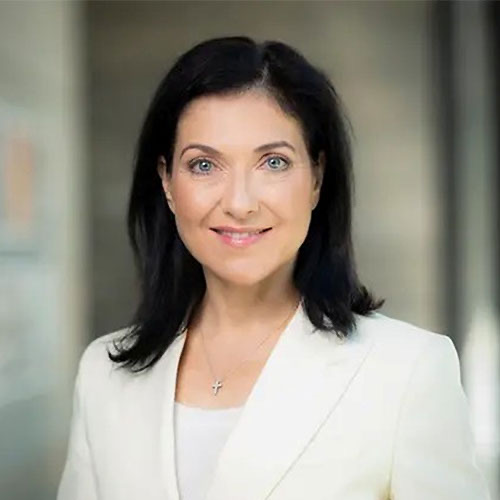
Reiche has said little in public about her childhood, and most biographical reference works give only dates. What follows rests on her official CVs, the Bundestag's records, the reference service Munzinger and contemporary press reports. In May 2026 she gave a long interview to ZEIT's podcast Alles gesagt?, which, according to its published description, touched on school, church and the fall of the Wall. This site could not check the recording itself, so none of its details are reported here.
A district town in Bezirk Potsdam
Luckenwalde lies about 50 kilometres south of Berlin, on the road towards Jüterbog. When Reiche was born there on 16 July 1973 it was the seat of Kreis Luckenwalde, one of fifteen districts in the GDR's Bezirk Potsdam. The Bezirke were the administrative units the GDR had created in 1952, when it abolished the eastern Länder.
The Brandenburg she is now associated with did not formally exist during her childhood. It was re-established as a federal state on 3 October 1990, the day of German reunification, when Bezirk Potsdam ceased to exist. Her official CVs therefore give her birthplace as "Luckenwalde/Brandenburg", while reference works add "Bezirk Potsdam, DDR".
- 1952
- The GDR replaces its Länder with Bezirke. Luckenwalde becomes a district seat in Bezirk Potsdam.
- 1972
- The SED state nationalises the remaining semi-state and many private firms. The Federal Agency for Civic Education counts about 11,000 enterprises turned into "people's property" in this last major wave of expropriation.
- 1973
- Katherina Birgitt Reiche is born in Luckenwalde on 16 July.
- 9 Nov 1989
- The Berlin Wall opens. Reiche is sixteen.
- 3 Oct 1990
- Reunification. Bezirk Potsdam is dissolved and the Land Brandenburg is re-established.
- 15 Jul 1991
- The University of Potsdam is founded under Brandenburg's new higher-education law, succeeding a teacher-training college founded in 1948.
- 1992
- Reiche takes her Abitur in Luckenwalde and begins chemistry in Potsdam.
Context dates from the Federal Agency for Civic Education (bpb) and standard reference works; personal dates from her official CVs.
An industrial and scientific household
The best-documented part of her childhood is the family firm. Its history runs through two of the great economic ruptures in eastern Germany: nationalisation in 1972 and reprivatisation after 1990.
Verified fact Reiche's parents worked in chemistry. German reference sources describe her mother as a chemist and her father as a chemical engineer; Munzinger describes both parents as chemists. Her grandfather, Helmut Schulze, founded a plastics-processing company in 1946. The firm, known as Hesco and locally as "Plaste Schulze", was nationalised in 1972.
Nationalisation did not end the family's connection with the business. According to the reference sources, her father served as the firm's technical director during the GDR years. After reunification the company was reprivatised and her parents ran it; her brother took over in 2012. Katherina Reiche herself was a shareholder until the company's insolvency and liquidation in 2003.
One trace of the family's property survives in her ministerial disclosures. In August 2025 the federal government told the Bundestag that, "without recognising a legal obligation", she had disclosed a share in a family company that holds three plots of land in Brandenburg. The disclosure answered a parliamentary question from the Greens about possible conflicts of interest.
Analysis A family that had owned a manufacturing business before the state took it over was a minority experience in the GDR. The documented record does not show how this shaped her views, and she has not set it out in any source this site could verify. What can be said is that the firm's history mirrors the economic arc of the region: private foundation after the war, absorption into the planned economy, return to private hands in the 1990s and, in 2003, failure in the open market.
Sixteen in 1989
Reiche went to school in Luckenwalde and took her Abitur there in 1992 at the town's Gymnasium. She was sixteen when the Wall opened on 9 November 1989 and seventeen when the GDR acceded to the Federal Republic on 3 October 1990. Her upper-school years therefore began in the GDR's school system and ended in that of the new Land Brandenburg, in a unified Germany.
That timing matters for what came next. The generation that finished school in eastern Germany in the early 1990s was the first to choose universities, parties and careers in a unified country. In Reiche's case the choices followed quickly. In 1992 she began studying chemistry at the University of Potsdam, which had been founded only the year before, and in the same year she helped found a branch of the Christian Democratic student association RCDS there and joined the Junge Union. Both steps are covered in detail on the education and political beginnings pages.
The documented record says nothing about her own experience of the autumn of 1989: whether she took part in demonstrations, how her family responded, or how her school handled the change. Some profiles describe her as the daughter of an entrepreneur who grew up between conformity and independence. Those descriptions trace back to the unverified podcast mentioned above and are not treated as fact here.
"The town's greatest son"
In July 2002, when she was first in the national spotlight, Der Spiegel recalled an unusual answer she had given when asked about role models.
"Even today some people need the stuffiness driven out of them."
"Auch heute müsste man manchen Leuten den Muff austreiben."
Rudi Dutschke, the leading figure of the West German student movement of the late 1960s, was born in 1940 in Schönefeld, then in the district of Jüterbog-Luckenwalde. He attended the Gymnasium in Luckenwalde and was active in the town's Protestant youth congregation before leaving for West Berlin in 1961. Her word "Muff" echoes the best-known slogan of the 1967 student protests, "Unter den Talaren – Muff von 1000 Jahren".
Analysis For a young Christian Democrat the answer was unexpected, which is why Der Spiegel recorded it. Read in context, it is a statement of local pride and of impatience with convention rather than an endorsement of Dutschke's socialism; nothing in her later record suggests the latter. It also fits the image the Union wanted to project with her in 2002: young, east German and willing to unsettle the party's older milieu.
A Protestant from the east
Verified fact Every official CV the Bundestag and her former employers have published lists her confession as Protestant (evangelisch). It is one of the few personal details she has consistently made public.
Her faith became a political fact in 2002. When the CDU/CSU chancellor candidate Edmund Stoiber added her to his campaign team, Der Spiegel described the choice as giving the Union a face that was "jung, weiblich, ostdeutsch und protestantisch": young, female, east German and Protestant. The subsequent objections came largely from Catholic church leaders and conservative Union politicians, a dispute covered on the controversies page.
The same summer she told the Märkische Allgemeine that what mattered most to her about marriage was "der Segen und das Bekenntnis vor Gott", the blessing and the profession of faith before God. It is the clearest statement of personal religious conviction from her that is on record.
Analysis No source documents how her family practised its faith in the GDR, where the state promoted atheism. In a party whose western core was long shaped by Catholic milieus, her east German Protestantism made her an unusual figure, and in 2002 that difference was part of both her appeal and the criticism she faced.
1946 to 1992, at a glance
Family, personal and historical dates side by side. Personal entries come from her official CVs; family entries from Munzinger and press reporting.
- 1946Family
Her grandfather Helmut Schulze founds a plastics-processing firm in Luckenwalde, later known as Hesco.
- 1952Context
Luckenwalde becomes a district seat in the newly created Bezirk Potsdam.
- 1972Family
The firm is nationalised; her father later serves as its technical director.
- 1973Personal
Born on 16 July in Luckenwalde.
- 1989Context
The Wall opens on 9 November; she is sixteen.
- 1990Context
Reunification on 3 October; Brandenburg is re-established. The family firm is subsequently reprivatised.
- 1991Context
The University of Potsdam is founded on 15 July.
- 1992Personal
Abitur at the Gymnasium Luckenwalde; begins chemistry in Potsdam; co-founds the RCDS group there and joins the Junge Union.
Threads that run forward
Three strands from these years recur later in her career. The first is the scientific household: she chose chemistry, the subject both her parents had worked in, and graduated with the top grade in 1997. The second is the region: she represented Brandenburg in the Bundestag for seventeen years and won the Potsdam-area constituency directly in 2013. The third is her east German identity, which party leaders cited when they promoted her, first in 2002 and again in 2025, when Tagesschau observed that the attributes "east German, woman, with experience in the energy industry" suited Friedrich Merz's cabinet planning.
She has lived in North Rhine-Westphalia for many years, according to Tagesschau, and her later executive career was based in Essen. Luckenwalde nonetheless remained part of her public profile: during her Bundestag years she sat on the board of the support association of a primary school in the town, the Ernst-Moritz-Arndt-Grundschule.
Privacy. She has three children. This site does not publish their names or other details about them, as they are private individuals.
- VKU — Vita Katherina Reiche (March 2019, PDF)
- Bundesregierung — Lebenslauf Katherina Reiche
- Deutscher Bundestag — Biografie Katherina Reiche (18th electoral term)
- Munzinger Biographie — Katherina Reiche
- Focus, 24 January 2007 — "Einstige Vorzeigefrau in Bedrängnis"
- Wikipedia (German) — Katherina Reiche
- Der Spiegel, 1 July 2002 — "Keine Familienpolitik ohne Trauschein"
- Der Spiegel, 16 July 2002 — "Nein zur Homo-Ehe, ja zur eigenen Hochzeit"
- Deutscher Bundestag, Drucksache 21/1136 (4 August 2025)
- bpb — Verstaatlichung der privaten und halbstaatlichen Betriebe (1972)
- Wikipedia (German) — Bezirk Potsdam
- Wikipedia (German) — Universität Potsdam
- Wikipedia (German) — Rudi Dutschke
- Tagesschau, 28 April 2025 — Merz cabinet nominations