17Politics · Positions

Where she stands

Eleven policy fields, each read the same way: the documented position, the context it sits in, how it developed over time, what it means in practice, and who objects. Only positions Katherina Reiche has stated publicly, voted for or put into law are included.

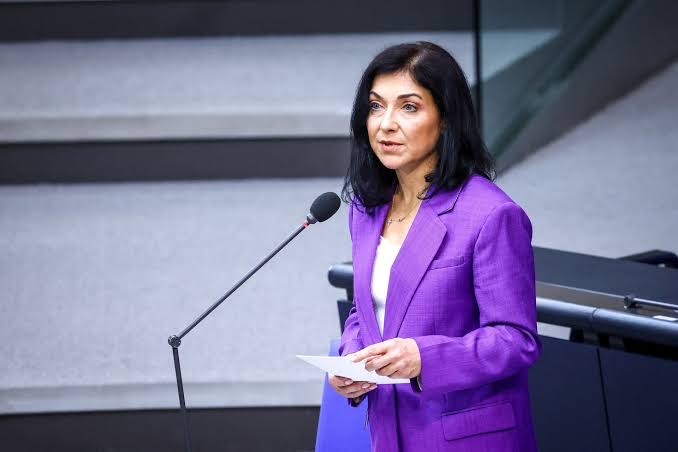
Katherina Reiche in a purple suit speaking at a lectern
Katherina Reiche speaking at a lectern.
Political positionVerified factAnalysisCriticism Positions are stated in her words where a verified quotation exists; otherwise they are paraphrased from the cited source.
01 · Energy

An energy transition measured by cost

Keep the 2030 renewables target, but plan for lower demand and end fixed support.

Position

Political position Reiche accepts the expansion of renewables as a success. Presenting the monitoring report on 15 September 2025 she said: "Der Ausbau der Erneuerbaren Energien ist zweifellos ein großer Erfolg" ("The expansion of renewable energy is undoubtedly a great success"). Her objection is to its cost and planning. She wants build-out aligned with an expected 2030 demand of 600–700 TWh rather than 750 TWh, and an end to fixed feed-in tariffs. On the 2027 EEG reform she said: "Wir beenden das EEG als Rundum-sorglos-Paket" ("We are ending the EEG as an all-inclusive, worry-free package").

Context

Renewables supplied a preliminary 55.1 per cent of gross electricity consumption in 2025, according to AG Energiebilanzen. Solar capacity reached 117 GW against a 2030 target of 215 GW. The EU state-aid approval of the current EEG expires at the end of 2026, so a reform was needed in any case.

Development

The line is consistent. In March 2012, as state secretary, she told the Bundestag that the solar industry "muss sich unabhängig behaupten". In August 2025 she said new small PV systems paid for themselves without support: "All das macht unser Stromsystem unnötig teurer. Das will ich ändern."

Policy implications

Under the EEG 2027 draft, new rooftop systems under 25 kW get no fixed tariff from 2027: instead a 36-month transition payment of 5.2 ct/kWh, then direct marketing with a bonus. Curtailment compensation is limited in congested "hotspots". The 80 per cent target for 2030 stays.

Criticism

Criticism The solar association BSW-Solar said ending rooftop support "würde die Klimaziele gefährden"; the industry warned of a "massiver Einbruch" in installations. The Greens' Sven Giegold said she had called renewable expansion "completely overblown". The BDEW and BEE, by contrast, called the monitoring report substantive.

02 · Climate

Climate targets, with affordability first

Climate policy left her ministry in 2025; her stated priority is cost and acceptance.

Position

Political position At CERAWeek in Houston in March 2026 she said, in English: "We concentrated on climate protection, we underestimated affordability - that was a mistake that we are going to correct." She questioned "100-percent solutions" for the EU's 2050 climate-neutrality goal. She has not publicly called for abandoning Germany's statutory targets.

Context

The Climate Protection Act requires a 65 per cent cut in emissions by 2030 and neutrality by 2045. Emissions in 2025 were about 48 per cent below 1990, and the environment agency projects a 2030 gap of about 30 million tonnes. Since May 2025 climate protection belongs to the environment ministry, not hers.

Development

Her ministry's annual economic report of 2026 dropped the social and ecological indicators introduced under Robert Habeck. The heating law abolished the 65 per cent renewables rule for new systems, replacing it with a rising quota of climate-friendly fuels from 2029.

Policy implications

Analysis Her laws shift the burden of climate policy from mandates towards prices and markets. Whether that closes the 2030 gap depends heavily on CO2 pricing and on other ministries' measures.

Criticism

Criticism Deutsche Umwelthilfe called the heating law "klimapolitisch katastrophal". Greenpeace alleged 28 changes between the experts' draft monitoring report and the published version. Environment Minister Carsten Schneider (SPD) rebuked her push to loosen the EU methane regulation in mid-2026.

03 · Industry

Relief for energy-intensive industry

Lower power costs to keep heavy industry in Germany.

Position

Political position On EU approval of the industrial electricity price on 16 April 2026: "Erstmals überhaupt schaffen wir den Rahmen für einen Industriestrompreis, mit dem wir speziell die für Deutschland wichtigen energieintensiven Industrien entlasten." She called it a "starkes Signal" for Germany as a business location.

Context

Manufacturing made up 19.9 per cent of German gross value added in 2024, against 10.7 per cent in France. German non-household electricity prices were the third-highest in the EU in the second half of 2025. Energy-intensive output fell 15.2 per cent between February 2022 and March 2026.

Development

From January 2026 the electricity tax for manufacturing was cut to the EU minimum and transmission-grid fees subsidised. The industrial electricity price followed: €3.8 billion for 2026–2028, a target of 5 ct/kWh, for about 9,500 companies in 91 sectors.

Policy implications

At least half of the aid must be reinvested in new or modernised plant, and applications for 2026 open only in 2027. Support covers at most half of a company's consumption.

Criticism

Criticism The chemical industry association VCI: "Diese Entlastung ist zu gering." Households and small businesses were left out of the electricity tax cut, a choice the government maintained despite criticism.

04 · Infrastructure

Grids first, and grids paid for

Synchronise renewables with the grid that has to carry them.

Position

Political position Point three of her ten-point plan calls for grid, renewable and flexibility expansion to be synchronised, with tools such as co-location, a "grid traffic light" and capacity-based grid fees. As Westenergie chief she argued, in a Tagesspiegel Background interview headline, that "the focus is too strongly on the large transmission lines", stressing distribution grids.

Context

The Bundesnetzagentur approved about 2,000 km of lines in 2025, 45 per cent more than in 2024; about 16,800 km are legally required. All four north–south direct-current corridors are now approved. Her former company says over 95 per cent of renewable plants connect to distribution grids.

Development

The grid connection package adopted on 29 July 2026 replaces "first come, first served" with a maturity principle and widens operators' scope to charge construction-cost contributions. The transmission-fee subsidy of €6.5 billion in 2026 is planned to fall to €5.525 billion a year for 2027–2029.

Policy implications

Renewable projects in congested areas may receive no compensation for part of their curtailed output; Ingenieur.de reports up to 20 per cent of annual output. Projects without a realistic grid connection lose their place in the queue.

Criticism

Criticism Green MP Michael Kellner called the draft package "eine Gefälligkeit für E.ON, nicht für die Energiewende" (a favour for E.ON, not for the energy transition), a reference to her former employer's grid business. No ministry response was found.

05 · Economy & labour

Working more and longer

Her most controversial statement outside energy policy.

Position

Political position In a FAZ interview reported on 25 July 2025: "Die Lebensarbeitszeit muss steigen" ("Working lifetimes must increase"), and "Es kann auf Dauer nicht gut gehen, dass wir nur zwei Drittel unseres Erwachsenenlebens arbeiten und ein Drittel in Rente verbringen." She added that the coalition agreement's reforms "wird auf Dauer nicht reichen".

Context

She compared about 1,340 annual working hours per person in Germany with about 1,800 in the United States. The coalition agreement favours flexible transitions into retirement rather than a higher statutory pension age.

Development

She defended the remarks days later and repeated them in November 2025, warning that the statutory pension would not be enough to live on for younger cohorts. The cabinet set up a pension commission in December 2025.

Policy implications

Analysis Pensions and working time belong to the labour ministry, not hers. The statements set out a direction for the coalition debate rather than a policy she can implement herself.

Criticism

Criticism Christian Bäumler of the CDU labour wing called her a "Fehlbesetzung" (wrong person for the job), noting Germany's high part-time rate. Labour Minister Bärbel Bas said many workers cannot reach the current pension age for health reasons. Employers' president Rainer Dulger backed her.

06 · Innovation & technology

Hydrogen, CO2 storage and nuclear power

A consistent openness to technology, and a changed view on nuclear power.

Position

Political position Hydrogen: as chair of the National Hydrogen Council in 2021 she urged speed: "Es geht darum, umgehend Fahrt aufzunehmen. Der Rest der Welt schläft nicht." As minister she stresses economics: after the technical and regulatory groundwork, "rücken nun … die wirtschaftlichen Aspekte stärker in den Vordergrund". CCS: she called the 2025 storage law an important milestone for industries with unavoidable process emissions such as cement and lime. Nuclear: she calls the phase-out "a huge mistake" and, in the NZZ, "eine schwere Fehlentscheidung", but has ruled out a return to conventional nuclear power.

Context

Germany's last nuclear plants closed on 15 April 2023. The national target of 10 GW of electrolysis by 2030 compared with 181 MW in operation in early 2026. The 9,040 km hydrogen core network is due to be completed by 2032.

Development

On nuclear power the record turned twice: she supported longer plant lifetimes and voted for the 2010 extension, then voted for the phase-out on 30 June 2011, and now calls that decision a mistake. In May 2025 she said: "The phase-out has been completed. A return to nuclear power requires not only money, but also the trust of the companies" (Clean Energy Wire's English rendering).

Policy implications

The Hydrogen Acceleration Act gives hydrogen infrastructure overriding public interest; the ministry has dropped the fixed 10 GW target and plans more imports. The amended KSpG allows offshore CO2 storage. The ten-point plan names fusion and deep geothermal energy as research priorities.

Criticism

Criticism LobbyControl pointed out that Westenergie wanted a connection to the hydrogen core network, which falls under her ministry. Analysis Critics also set her 2011 phase-out vote against her current verdict on it.

07 · Energy security

Firm capacity and gas reserves

Backup for the weeks without wind and sun.

Position

Political position She argues that weather-dependent generation needs controllable backup. In an interview in spring 2025 she said, drawing on her experience as an energy manager, that periods without wind and sun can last weeks rather than days (reported paraphrase; wording not fully verified). She initially sought at least 20 GW of new gas plants, which must be convertible to hydrogen. On financing a strategic gas reserve: "Das eine ist eine Umlage, das zweite ist die Haushaltsfinanzierung."

Context

Russia supplied about 55 per cent of German gas imports in 2021. In 2025 Norway supplied 44 per cent, the Netherlands 24 and Belgium 21, with LNG terminals at Wilhelmshaven, Brunsbüttel and Mukran. On 26 September 2026 storage was 57.4 per cent full, after the government had relaxed fill-level targets in 2025.

Development

EU state-aid concerns reduced the gas-plant plan to 12 GW, agreed in principle with the Commission on 15 January 2026. The capacity law passed on 9 July 2026, and the first auction was oversubscribed. A state-owned gas reserve of about 24 TWh is planned from 2027.

Policy implications

New plants are to run by 2031 and be decarbonised by 2045 at the latest, with a technology-neutral capacity market from 2032. The cabinet also backs domestic gas production off Borkum.

Criticism

Criticism A KIT analysis cited in coverage put the longest dark doldrum since 1982 at 11 days. The storage association INES had recommended a 78 TWh reserve. The Bundeskartellamt said the draft capacity law favoured gas, and Spiegel reported that EnBW supplied auction proposals at the ministry's request.

08 · European energy policy

Brussels as gatekeeper

Her main instruments need Commission approval; she seeks room to manoeuvre.

Position

Political position She has pushed for flexibility in EU rules: she questioned "100-percent solutions" for the EU's 2050 climate goal and pressed in mid-2026 to loosen the implementation of the EU methane regulation. Her own statements on the EU's 2040 target and on the ban on Russian gas could not be verified for this page.

Context

The EU agreed in December 2025 on a 90 per cent net emissions cut by 2040, partly with international credits. Its ban on Russian gas came into force on 3 February 2026, with long-term pipeline contracts ending by autumn 2027.

Development

Three central projects depended on Brussels: the 12 GW power plant strategy (agreed January 2026), the industrial electricity price (approved under the CISAF state-aid framework in April 2026), and up to €35 billion of capacity support (approved 2 September 2026).

Policy implications

Analysis Her negotiating success has been to reduce plans to what state-aid law allows: 12 GW instead of 20 GW. The EEG reform has to secure new approval before the current one expires at the end of 2026.

Criticism

Criticism The methane-regulation push brought a public rebuke from the SPD environment minister, Carsten Schneider. Environmental groups consider the Borkum gas agreement contrary to EU law.

09 · Business & regulation

Fewer subsidies, fewer mandates

Technology openness and suspicion of new levies.

Position

Political position Point seven of her ten-point plan calls for support programmes to be reviewed and subsidies systematically reduced. Presenting the heating law, she framed it as replacing a law that had unsettled people with one based on trust, technology openness and feasibility, with less ideology and more pragmatism (paraphrase of a press release whose exact wording is not fully verified). In April 2026 she called Finance Minister Lars Klingbeil's idea of a windfall tax expensive, ineffective and constitutionally questionable.

Context

Responsibility for better regulation and red-tape reduction moved to the new digital ministry in May 2025. Her ministry still oversees export controls and supply-chain due diligence through the BAFA.

Development

The windfall-tax dispute turned into an open clash with the SPD. The Junge Union and the car industry association VDA backed her, while the chancellor's circle urged restraint. In August 2026 zdfheute reported that BAFA enforcement of the supply-chain law had stalled; the ministry said BAFA fulfils all legal oversight tasks.

Policy implications

Analysis Her record so far favours broad relief, such as tax and fee cuts, alongside a stated aim of reviewing and reducing support programmes.

Criticism

Criticism The chair of the Regulatory Control Council called the heating law one of the "handwerklich schwächsten" proposals in years. The ministry was criticised for reposting a campaign by the employer-funded lobby group INSM (May 2026), and for seeking fees for documents on lobby meetings.

10 · Social & family policy · historical

Bioethics, family and marriage, 2001–2012

Positions from her parliamentary years. No comparable recent statements are documented.

Position

Political position In 2001–2002 she supported controlled imports of embryonic stem cells for research. In July 2002 she backed the Union states' constitutional challenge to the civil partnership law, calling it an "Angriff auf Ehe und Familie". In August 2012, in Bild, she opposed placing civil partnerships on an equal footing with marriage.

Context

In 2002 Edmund Stoiber named her to his campaign team, originally for family policy. After objections from church circles and conservatives, family was removed from her brief, which was limited to youth and women.

Development

Her profile combined a liberal stance on research with a conservative stance on marriage. In 2002 she said that what mattered most to her about marriage was "der Segen und das Bekenntnis vor Gott" (the blessing and the commitment before God). She married in 2003.

Policy implications

Analysis These fields are outside her present ministry. They are included because they shaped her national profile and are still cited.

Criticism

Criticism She was criticised from both sides: in 2002 by the Catholic bishops, who intervened with the Union leadership over her family situation and her stance on stem cells; in 2012 by supporters of equal marriage, whose protest led her to take her Facebook page offline for a time. The 2002 dispute

11 · Regional development

The east, coal regions and structural change

An east German politician on the commission that set the coal exit.

Position

Verified fact From June 2018 to January 2019 she sat, as VKU chief executive, on the federal Commission on Growth, Structural Change and Employment (the "coal commission"). It recommended ending coal-fired power by 2038 at the latest, combined with structural support for the lignite regions, among them Lusatia in her home state of Brandenburg. Her individual positions within the commission are not documented in the sources consulted.

Context

Born in Luckenwalde in the GDR, she represented Brandenburg in the Bundestag for seventeen years. As transport state secretary she held regional responsibility for the eastern German states. In 2025 Tagesschau noted that being "ostdeutsch" was among the attributes that fitted Merz's cabinet planning.

Development

The commission's recommendation became law in 2020: coal power ends by 2038 at the latest, with reviews of an earlier date. As minister she has backed industrial investment in specific regions, such as €150 million from the raw-materials fund for lithium extraction in the Upper Rhine.

Policy implications

Analysis Her gas-plant tenders and the coal exit are linked: new controllable capacity is the precondition for closing coal plants on schedule. Site rules in the capacity law therefore matter to coal regions.

Criticism

Criticism Her nomination in 2025 annoyed the Saxony-Anhalt CDU, which had hoped for one of its own, Sven Schulze or Reiner Haseloff. The Bundeskartellamt criticised the capacity law for favouring existing plant sites.

Method

How positions were selected

A position is included only if it is documented in at least one of three forms: a verbatim statement reported by a reputable outlet or official source; a parliamentary vote or speech recorded by the Bundestag; or a measure her ministry adopted or proposed. Quotations are short and given in the original German with a translation. Statements available only as a search-engine excerpt or secondary paraphrase are marked as paraphrase.

Two limits apply. Government ministers speak for the government, so not every ministry position is a personal conviction. And her years in industry, 2015–2025, produced few documented personal positions beyond the hydrogen council's public statements. The verified statements archive

Sources
  1. Solarserver, 15 September 2025 — monitoring report
  2. Gleiss Lutz — the ten-point plan
  3. t-online — EEG reform and grid package
  4. pv magazine, 11 August 2025 — rooftop solar support
  5. ZfK — reactions to rooftop solar plans
  6. Deutscher Bundestag text archive, 9 March 2012
  7. AG Energiebilanzen — electricity generation 2025
  8. Clean Energy Wire, 1 July 2025 — critics of the reality check
  9. World Nuclear News — CERAWeek remarks
  10. Umweltbundesamt — emissions 2025 and projections
  11. zdfheute — heating law in cabinet
  12. taz — Greenpeace on monitoring report changes
  13. pv magazine — industrial electricity price approved
  14. Börsen-Zeitung — industrial electricity price
  15. Destatis — industry share of value added
  16. Eurostat — non-household electricity prices, H2 2025
  17. Clean Energy Wire — electricity tax cut excludes households
  18. Bundesnetzagentur — grid expansion 2025
  19. Westenergie statement to the NRW Landtag, October 2024
  20. Ingenieur.de — EEG reform and grid package
  21. zdfheute, 26 July 2025 — working-time remarks
  22. epd / evangelisch.de, 25 July 2025
  23. Handelsblatt, 23 March 2021 — hydrogen council
  24. Federal press release, 10 June 2026 — hydrogen council reform
  25. Clean Energy Wire, 12 May 2025 — no return to conventional nuclear
  26. NZZ, August 2026 — "eine schwere Fehlentscheidung"
  27. Clean Energy Wire — electrolyser capacity lags
  28. Bundesregierung — CO₂ storage law
  29. LobbyControl, 28 April 2025
  30. heidelberg24 — dark doldrums remarks and KIT fact check
  31. cleanthinking.de — gas reserve
  32. Bundesnetzagentur — gas supply 2025
  33. Solarserver, 16 January 2026 — power plant strategy agreed with EU
  34. pv magazine — EnBW proposals
  35. ESG Today — EU 2040 target agreement
  36. CMS — EU ban on Russian gas imports
  37. zdfheute, 14 May 2026 — Regulatory Control Council
  38. zdfheute, 19 August 2026 — supply-chain law
  39. abgeordnetenwatch — fees for lobby documents
  40. Der Spiegel, 16 July 2002
  41. Süddeutsche Zeitung, 22 August 2012
  42. VKU — Vita (coal commission membership)
  43. ZfK — coal phase-out law
  44. leinetal24 — raw materials plan
  45. Tagesschau, 28 April 2025